If you’ve not had an eye test for a while, it is natural to wonder exactly what will happen when you sit in the examination chair. Will you have to read tiny letters? What are all the machines for? And how long does an eye test take?
A routine eye examination is much more than a check to see whether you need new glasses. Your optometrist assesses how well you see, examines the health of your eyes, and performs any additional tests appropriate to your needs.
At D.I. Blow Opticians, our eye examinations are thorough, professional, and reassuring. We use experienced clinical judgement alongside advanced technology, including retinal imaging and 3D OCT scanning where appropriate.
Step 1: Discussing Your Vision, Eye Health and Medical History
A comprehensive eye exam usually begins with a conversation. Your optometrist will ask questions to build a picture of your vision, eye health, and general health. Depending on your circumstances, this may include:
- Whether you have noticed any changes to your vision
- Any symptoms affecting your eyes, such as blurred vision, flashes, floaters, or discomfort
- Your current glasses or contact lenses
- Your previous prescription and when you last had an eye test
- Your work, hobbies, and everyday visual requirements
- Whether you drive
- Your general health and relevant medication
- Your family’s history of eye or general health conditions
This information matters because an eye examination should be tailored to you. Your symptoms, health, family history, and visual needs can all help determine which assessments are necessary. Professional guidance from the College of Optometrists also requires optometrists to assess relevant history, symptoms, and visual needs as part of an adequate optical consultation.
For example, someone who spends all day working on detailed screens may have different visual requirements from someone who regularly drives at night or uses glasses mainly for reading.
Step 2: Checking How Clearly You Can See
One of the most familiar parts of an eye test is the visual acuity test. You will usually be asked to look at a chart containing letters or symbols and identify what you can see. Your vision may be checked:
- Without glasses or contact lenses, where appropriate
- With your current correction
- One eye at a time
- At different distances
This helps your optometrist measure how clearly each eye can see. However, this is only part of the examination. Being able to read the chart does not, by itself, tell your optometrist everything they need to know about your prescription or the health of your eyes.
Step 3: Measuring Your Prescription
If you are wondering what happens during an eye test when the optometrist asks, “Which is clearer, one or two?”, this stage is called refraction.
Your optometrist assesses how light is focused by your eyes to establish whether you have a refractive error such as:
- Short-sightedness
- Long-sightedness
- Astigmatism
- Age-related difficulty focusing at near distances (presbyopia)
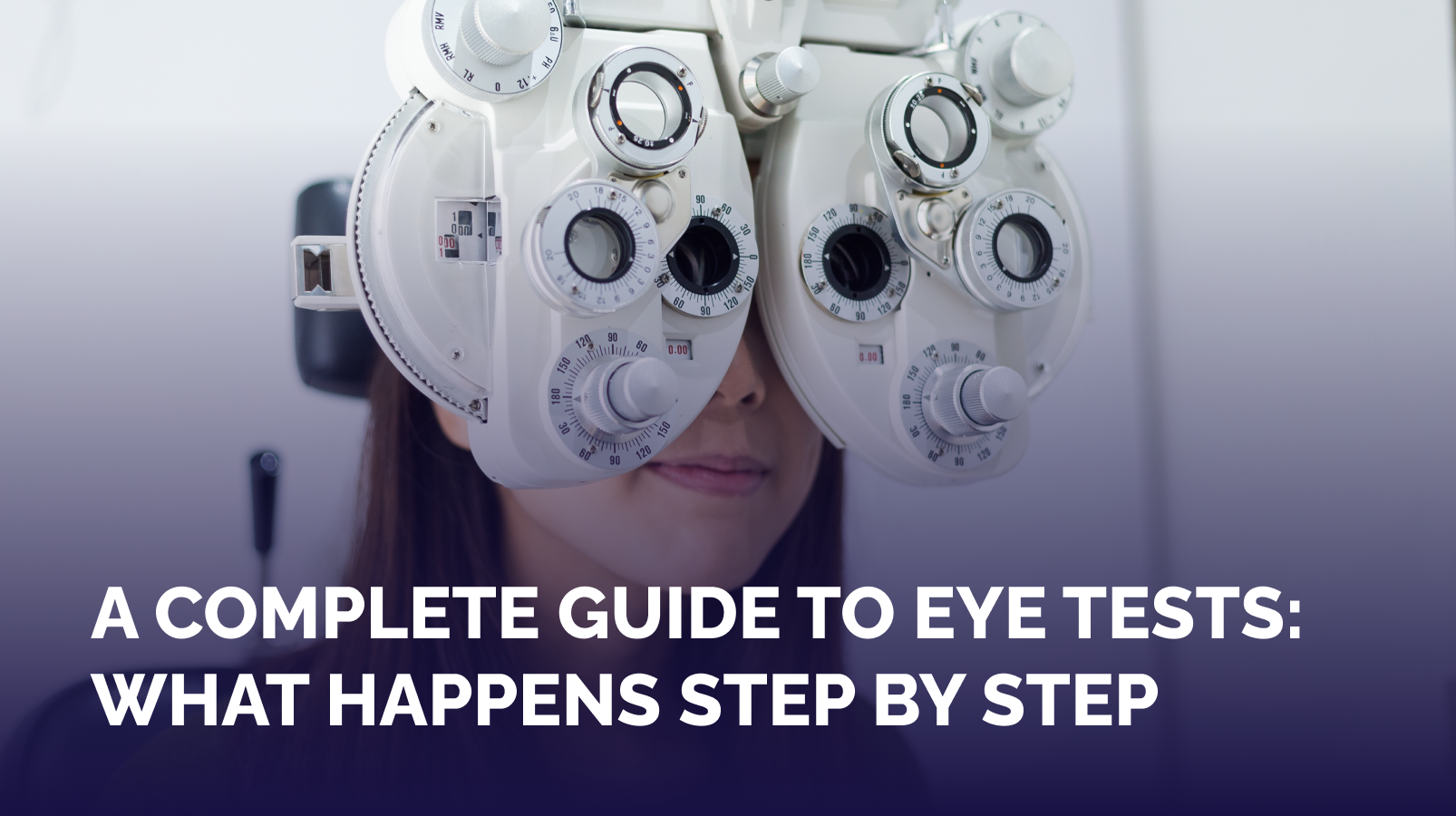
You may look through a series of lenses whilst identifying which options provide the clearest and most comfortable vision. An automated instrument may also provide an objective measurement or starting point. However, automated measurements do not replace your optometrist’s clinical assessment. The College of Optometrists notes that optometrists remain responsible for interpreting and integrating findings from automated instruments and other tests when reaching a conclusion.
The aim is not to find the strongest lenses. Your optometrist determines the prescription that is clinically appropriate and suitable for your vision.
Step 4: Assessing How Your Eyes Work Together
A comprehensive eye exam may also include tests to assess how your eyes work as a pair. Your optometrist may check areas such as:
- Eye alignment
- Eye movements
- How your eyes work together at distance and near
- Focusing ability
- Convergence, where clinically appropriate
These tests can be particularly important when investigating symptoms such as eye strain, headaches, double vision, or difficulty maintaining comfortable vision during close work.
The exact tests used will depend on your symptoms and clinical needs. Not every patient requires every possible test at every appointment.
Step 5: Examining the Front of Your Eyes
Your optometrist will examine the external structures of your eyes and may use specialised equipment to look more closely at areas, including the:
- Eyelids
- Surface of the eye
- Cornea
- Iris
- Lens
A slit lamp, which uses a bright and highly focused beam of light, may be used to provide a detailed view of the front of the eye. This part of the eye test is painless. You may be asked to look in different directions or keep your eyes still while your optometrist examines specific structures.
Step 6: Checking the Inside and Back of Your Eyes
One of the most important parts of a routine eye exam is assessing the health of the insides of your eyes.
Your optometrist examines structures including the retina and optic nerve, looking for signs of injury, disease, or abnormality. UK professional guidance states that a sight test must include internal and external examinations of the eye, together with any additional examinations necessary to detect relevant signs of disease or abnormality. Depending on your needs and available equipment, this assessment may involve direct examination, imaging, or other clinically appropriate methods.
At D.I. Blow Opticians, we also offer advanced technology including retinal imaging and 3D OCT scanning. These tests can provide detailed information about the structures of the eye when clinically appropriate.
An OCT scan is a separate, highly detailed imaging assessment and may be recommended as part of your care depending on your eye health, symptoms, and risk factors. You can learn more in our guide What Is an OCT Scan and Do You Need One?
Step 7: Additional Tests Where Needed
Not every eye test is identical. Your optometrist may recommend additional tests based on your age, symptoms, family history, general health, or findings from the examination. These could include:
Eye Pressure Measurements
Intraocular pressure may be measured when clinically appropriate, particularly when assessing someone at risk of glaucoma.
Visual Field Testing
This assesses your peripheral vision and may be relevant when investing certain eye or neurological concerns.
Retinal Imaging
Images of the back of the eye can help record and assess retinal structures.
OCT Scanning
Optical Coherence Tomography uses light to produce detailed cross-sectional images of structures within the eye.
The key point is that a comprehensive examination is not a fixed sequence of identical tests for everyone. Your optometrist uses their professional judgement to determine what is appropriate for you.
Step 8: Discussing Your Results
Once your examination is complete, your optometrist will explain what they have found and discuss any recommendations. This might include:
- Whether your prescription has changed
- Whether you need glasses or any updated prescription.
- Whether your current glasses are still suitable
- Any eye health findings
- Whether further tests are recommended
- Whether you should be referred for further assessment
- When you should have your next eye exam
If you don’t need a prescription or it hasn’t changed, you can receive a written statement confirming this.
You should also never feel obliged to buy glasses from the practice where you had your eye test. NHS guidance confirms that you should be provided with your prescription or an appropriate written statement following your examination, and the College of Optometrists states that selling or supplying glasses or contact lenses must not be a condition of performing a sight test.
How Long Does an Eye Test Take?
At D.I. Blow Opticians, eye exam appointments usually take around 30 minutes. However, an appointment may take longer if additional tests are needed. The exact length can depend on factors such as:
- Your symptoms and reason for visiting
- Whether you’ve noticed changes in your vision
- Your eye and general health history
- Whether additional assessments are clinically appropriate
- Whether further imaging or testing is required
A longer appointment does not necessarily mean that there is a problem. Sometimes extra time is simply needed to carry out a thorough assessment or investigate a particular aspect of your vision or eye health.
Understanding what happens during an eye test can make your appointment feel much less daunting. From checking how clearly you can see to assessing your eye health, every stage helps build a clearer picture of your vision and your individual needs.
At D.I. Blow Opticians, our experienced optometrists provide comprehensive eye exams with a careful and reassuring approach.
If it has been awhile, book your next eye test with D.I. Blow Opticians.