Starting school brings plenty of new challenges for children, from learning to read and write to following lessons on the whiteboard and taking part in sports and playground activities. But sometimes, what looks like a learning, concentration, or confidence issue could actually be connected to your child’s vision.
Children don’t always realise they cannot see clearly. If their vision has gradually blurred, they may assume everyone sees the world the same way. This is one reason regular eye tests are important. Undetected problems can affect both development and education.
Signs of Eyesight Problems in Children at School
Some children will tell you directly that they cannot see the board or that their eyes hurt. Others may show less obvious changes in their behaviour, schoolwork, or confidence. Here are some signs worth paying attention to:
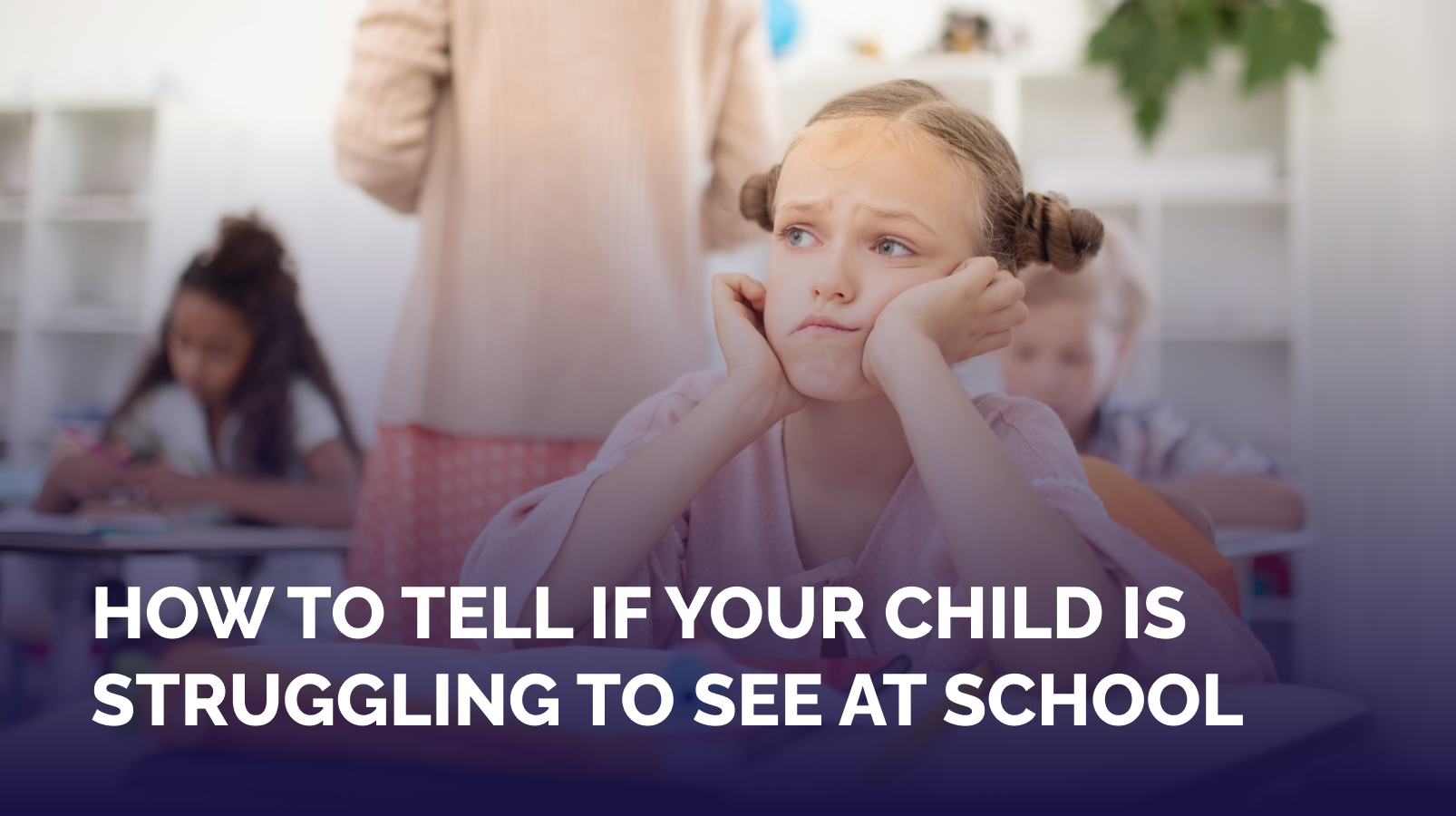
They Struggle to See the Whiteboard
One of the clearest signs of a potential distance-vision problem is difficulty seeing what is written or displayed at the front of the classroom. Your child might:
- Ask to sit closer to the board
- Copy information incorrectly
- Leave work unfinished because they cannot see the instructions
- Frequently ask a teacher or another child what is written
- Squint when looking across the classroom
- Avoid looking at the board altogether
Short-sightedness (myopia) may explain this. It makes distant objects appear blurred, while close objects can usually be seen more clearly. However, other factors can cause difficulty seeing at distance, so an eye exam is the best way to determine what is happening.
Reading Becomes Noticeably Difficult
Reading involves more than recognising letters. Children need to focus comfortably, track words across a page, and use both eyes together. Watch for behaviour such as:
- Losing their place while reading
- Skipping words or lines
- Holding books unusually close to their face
- Frequently moving their head when reading
- Avoiding reading altogether
- Becoming tired or frustrated while reading
- Complaining that words look blurry
Importantly, struggling with reading does not automatically mean your child has a sight problem. There are many reasons why a child finds reading difficult. An eye exam can help rule out vision as a contributing factor.
They Complain of Headaches After School
Does your child regularly come home from school with a headache, particularly after a day involving lots of reading, writing, or looking at the board?
Headaches can have many causes, so don’t automatically attribute them to eyesight. However, headaches and eye strain can be signs that a child is having difficulty with their vision. Track when the headaches happen. If they seem to occur repeatedly after visually demanding activities, mention this when arranging an eye test.
Their Concentration Seems to Disappear During Visually Demanding Work
A child who cannot see comfortably may find it harder to concentrate on activities that require sustained visual attention. For example, they may become restless during:
- Reading
- Copying from the board
- Writing
- Looking at worksheets
- Computer-based lessons
- Homework
It’s easy to assume a child is simply distracted or not trying hard enough. However, if concentration problems consistently appear during tasks that require close or distance vision, it is worth considering whether their eyesight could be contributing.
They Suddenly Start Avoiding Reading or Schoolwork
A child who previously enjoyed reading may begin avoiding books, homework, or other visually demanding activities. You might hear:
- “I don’t want to read”
- “I can’t do it”
- “It’s boring”
Of course, these statements can have many explanations. But if reluctance is accompanied by squinting, headaches, rubbing their eyes, holding books close, or difficulty copying from the board, it may be worth arranging a children’s eye test.
Their Schoolwork Is Unexpectedly Messy or Inaccurate
Vision problems can sometimes affect how confidently a child works with written information. For example, they may:
- Copy letters or numbers inconsistently
- Miss words when copying
- Struggle to keep writing aligned
- Make more mistakes when working from the board than a book
- Take considerably longer to complete written tasks
- Become frustrated with written work
Again, none of these signs proves that a child has an eyesight problem. But a noticeable change in schoolwork, particularly when combined with other visual symptoms, is a good reason to investigate further.
They Struggle with Hand-Eye Coordination
Good vision is important for activities that require the eyes and hands to work together. A child experiencing visual difficulties may struggle with activities such as:
- Catching or throwing a ball
- Handwriting
- Drawing
- Using scissors
- Building models
- Taking part in certain sports
They Frequently Rub or Cover One Eye
Frequent eye rubbing can have several causes, including tiredness, irritation, and allergies. It can also happen when a child has visual discomfort.
Similarly, if your child regularly closes or covers one eye when reading, watching TV, or looking into the distance, mention this to an optometrist.
They Seem Unusually Clumsy
Children naturally have accidents and can be clumsy, especially as they develop coordination. However, if your child consistently bumps into objects, misjudges distances, or struggles with activities that require them to judge where something is in space, their vision may be worth checking.
A Teacher Mentions They Are Struggling
Sometimes the first person to notice a potential problem is not a parent but a teacher. Teachers see children working in different situations throughout the day and may notice that a child:
- Squints at the board
- Copies information incorrectly
- Moves closer to the front
- Struggles with reading
- Avoids certain classroom activities
- Has difficulty completing visually demanding tasks
If a teacher raises concerns about your child’s ability to see, take them seriously and discuss the observations with an optometrist.
Could Eyesight Problems Look Like a Learning or Concentration Problem?
Potentially, yes. This does not mean that every child struggling academically has a vision problem. Learning difficulties, attention difficulties, developmental differences, tiredness, and many other factors can affect school performance.
However, vision is an important part of how children interact with written information, classroom displays, and their surroundings. A child may also be unable to explain what they are experiencing because they have never known any different. Rather than saying “I can’t see the board clearly”, they may just stop copying from it or assume the work is difficult. This is why looking at patterns of behaviour can be more useful than waiting for your child to complain about their eyesight.
What Eyesight Problems Can Affect Children?
A child’s eye examination can identify a range of visual problems. These can include:
- Myopia (short-sightedness): Distant objects appear blurred.
- Hyperopia (long-sightedness): Focusing on nearby objects can be difficult.
- Astigmatism: An irregularly curved cornea or lens can cause blurred or distorted vision.
- Amblyopia (lazy eye): Vision in one eye does not develop normally.
- Strabismus (squint): The eyes do not align in the same direction.
- Colour Vision Deficiency: Difficulty distinguishing certain colours.
Good vision can make a significant difference to how comfortably a child can engage with the world around them. If your child is squinting at the whiteboard, struggling with reading, complaining about headaches, or behaving differently during visually demanding activities, don’t assume they’ll just grow out of it.
Children do not always recognise or communicate that their vision is unclear. A routine eye test can provide reassurance and, if a problem is identified, help ensure your child receives the appropriate support.
At D.I. Blow Opticians, we provide children’s eye exams in a friendly, reassuring environment, including free NHS eye tests for eligible children. If you are concerned that your child may be struggling to see at school, our team can assess their vision and talk you through the results.