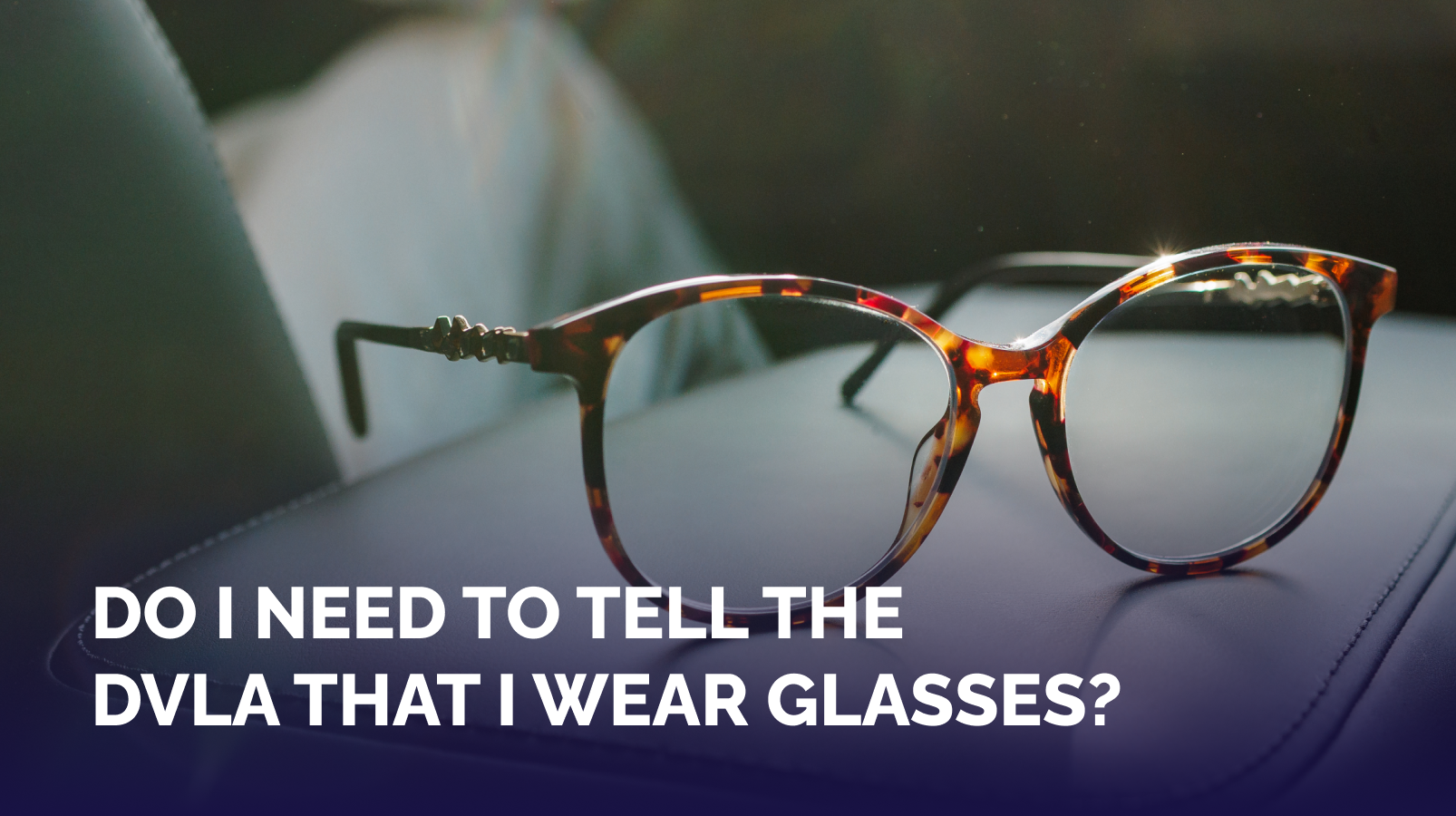
If you’re a driver in the UK and wear glasses, you might be wondering: do I need to tell the DVLA I wear glasses? This is a common question, especially as we rely on clear vision for safe driving. At D.I. Blow Opticians, we aim to give you clarity on UK driving vision requirements, explain when you must notify the Driver and Vehicle Licensing Agency (DVLA) about your eyesight, and help you understand how regular eye tests play a vital role in keeping you safe on the road.
Driving Eyesight Rules
According to the GOV UK website, you must wear glasses or contact lenses every time you drive if you need them to meet the ‘standards of vision for driving’.
You must tell the DVLA if you’ve got any problem with your eyesight that affects both of your eyes, or the remaining eye if you only have one eye.
This does not include being short-sighted or long-sighted or colour-blind. You also do not need to say if you’ve had surgery to correct short-sightedness and can meet the eyesight standards.
When you apply for a driving license, you must state whether you wear glasses when driving; your license is usually endorsed with code 01.
If You Need an Eye Test
If you report a medical condition that affects your vision, the DVLA may refer you for an eyesight test with their contracted optician. You do not have to pay for the test.
The DVLA then considers all medical evidence provided with a driving license application, including the eyesight test result.
If you choose to get your eyesight test from somewhere else, you can submit the results done by another optician as long as it includes an ‘Esterman visual test’. The DVLA does not guarantee that they will accept an eyesight test conducted by other opticians. You will need to pay for the test yourself.
Eye Conditions and Driving
You must tell the DVLA if you have certain eye conditions. These conditions are:
• Blepharospasm
• Diabetic retinopathy (with laser treatment)
• Diplopia (double vision)
• Glaucoma
• Nyctalopia (night blindness)
• Retinitis pigmentosa
You must also tell the DVLA if any of the following apply:
• Your eye condition affects both eyes
• Your eye condition affects one eye, but you only have vision in that eye
• You have retinitis pigmentosa that affects one or both eyes
• A GP, optician, or eye specialist has said you should not drive
• You do not meet the visual standards for driving
Be aware that you can be fined up to £1,000 if you do not tell the DVLA about a medical condition that affects your driving.
If a Health Condition Affects Your Driving
You can voluntarily give up your license. You might choose to do this if, for example:
• Your doctor tells you to stop driving for 3 months or more
• Your medical condition affects your ability to drive safely and lasts for 3 months or more
• You do not meet the required standards for driving because of your medical condition
You’ll need to tell the DVLA and send them your license.
How Reporting Works
If you do need to inform the DVLA about a vision condition:
• Report Online or By Form: Most people can report a condition online through the GOV.UK service. In special cases, you may need to fill in a paper form (Form V1).
• DVLA Assessment: The DVLA may require further evidence or refer you for an eyesight test arranged by them, at no cost to you.
• License Decision: The DVLA will review medical evidence before deciding whether your license remains valid, needs conditions, or needs to be revoked.
Standard of Vision for Driving
You must be able to read a number plate from 20 metres away (about the length of 5 parked cars). You can wear your glasses or contact lenses if you use them for driving.
You must all meet the minimum eyesight standard for driving by having a visual acuity of at least a decimal 0.5 (6/12) measured on the Snellen scale (with glasses or contact lenses, if necessary) using both eyes together or, if you have sight in one eye, in that eye.
You must also have an adequate field of vision; your optician can tell you about this and do a test.
Lorry & Bus Drivers
You must have a visual acuity of at least 0.8 (6/7.5) measured on the Snellen scale in your best eye and at least 0.1 (6/60) on the Snellen scale in the other eye.
You can reach this standard using glasses with a corrective power not more than +8 dioptres, or with contact lenses. There’s no specific limit for the corrective power of contact lenses.
You must have an uninterrupted horizontal visual field of at least 160 degrees with an extension of at least 70 degrees left and right, and 30 degrees up and down. No defects should be present within a radius of the central 30 degrees.
In summary, you don’t have to tell the DVLA simply because you wear glasses. What matters is whether your vision meets the legal requirements for safe, consistent driving. However, if you have a condition that affects your sight significantly, or you cannot meet vision standards even with glasses, then you must notify the DVLA.
Not sure who to see about a vision concern? Our guide to the difference between an optician, optometrist and ophthalmologist explains who does what. And if you spend long hours at a screen, it’s also worth reading about VDU syndrome and how it can affect your eyes.
If you’re worried about your eyesight, book in for a comprehensive eye exam with D.I Blow Opticians today.